
It's APS Innovation Month and, like many people across the public sector, I've been reflecting on innovation and what it really looks like in practice.
One thing I've noticed throughout my career is that organisations rarely suffer from a shortage of ideas. In fact, most teams I have worked with can identify dozens of opportunities for improvement without much effort at all. The challenge seems to come later, when we try to determine whether an idea is good enough to pursue.
The idea gets discussed. We consider the risks, explore the dependencies, think through the implementation approach and identify the stakeholders who need to be consulted. None of these are bad things, of course. They are often necessary. Yet I sometimes wonder whether, in our pursuit of confidence and consensus, we accidentally create a different problem: by the time we've decided whether an idea is worth trying, we've delayed the very learning that would have told us whether it was worthwhile in the first place.
Perhaps this is because when most people hear the word innovation, they instinctively think big. We think about new technologies, large transformation programs, major policy reforms or wholesale redesigns of services and processes. Our attention is naturally drawn towards the complex and the consequential.
But innovation doesn't always arrive in those forms.
That's one of the reasons I've always been drawn to the philosophy of kaizen (meaning ‘continuous improvement’) and the lessons that emerged from the Toyota Production System.
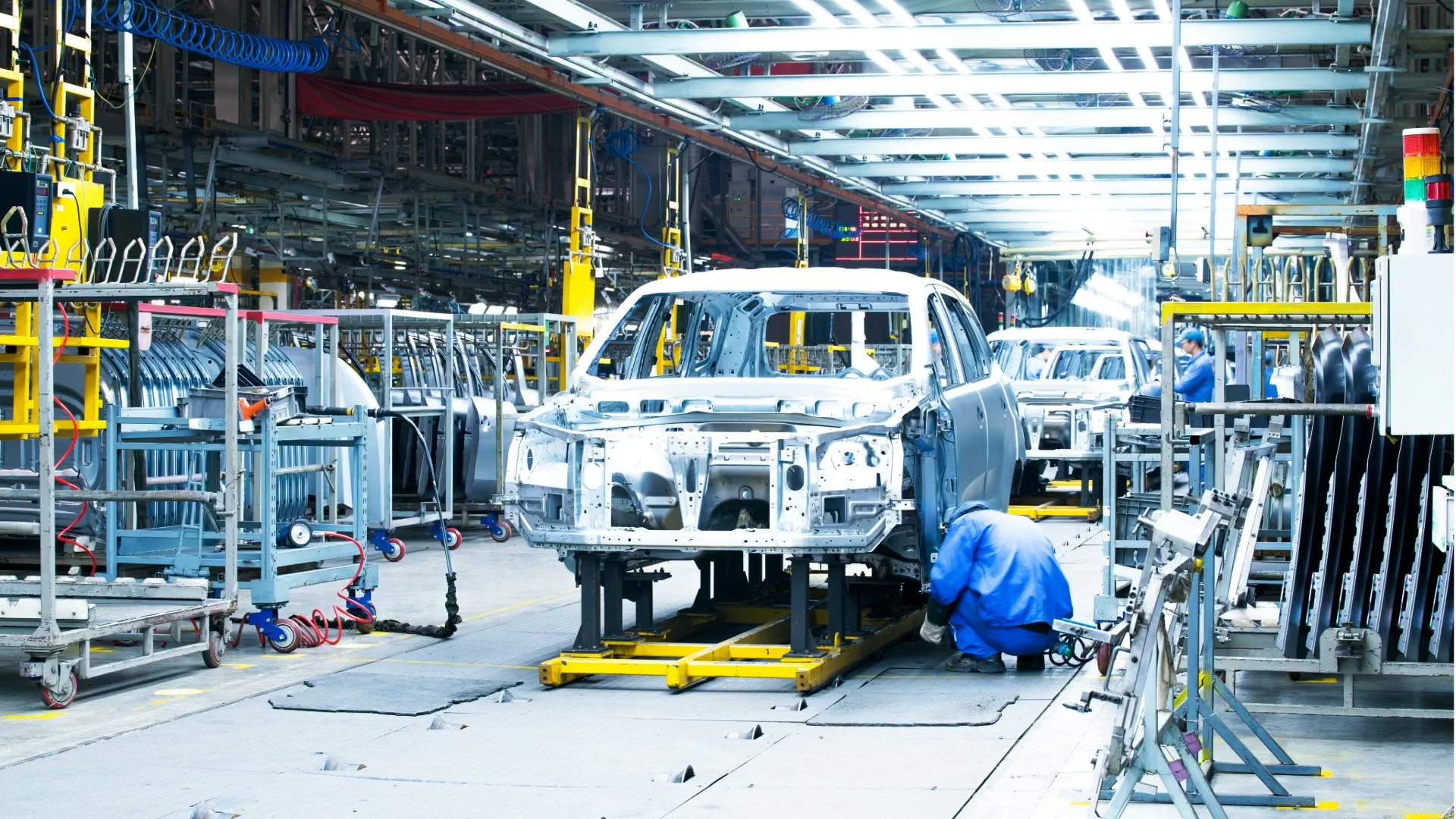
There is a famous story from Toyota's assembly lines. Imagine you're a technician building vehicles and you notice something isn't quite right. A component isn't fitting correctly, a defect has appeared, or a process isn't working as intended. In many workplaces, your options would be limited. You would continue doing your job and trust that somebody, somewhere further down the line, would eventually discover the problem.
Toyota took a different approach.
Workers were given access to what was called an Andon cord; a physical cord running alongside the production line that could be pulled when a problem was identified. Pulling the cord would alert support staff and, if necessary, stop production while the issue was investigated and resolved. The purpose was not to create disruption. In fact, it was precisely the opposite. Toyota understood that addressing a problem when it first appeared was usually cheaper, faster and more effective than allowing it to propagate through the system.
What has always interested me about that story isn't the cord itself.
It's the philosophy behind it.
Someone made a deliberate decision to trust the people closest to the work. More importantly, they reduced the time between identifying a problem and acting on it. Rather than optimising for certainty, they optimised for learning.
That idea has stuck with me because I think it has relevance far beyond manufacturing.
When I look at innovation efforts in large organisations, I sometimes wonder whether our biggest constraint is not creativity, funding or even capability. Perhaps our biggest constraint is the time that exists between seeing an opportunity and feeling comfortable enough to test it.
A surprisingly mundane example from my own life helped crystallise this for me.

Not long ago, I moved the cutlery drawer in my kitchen.
For years, the cutlery sat above a cupboard full of containers and Tupperware. One day I found myself unloading the dishwasher and thought: why isn't the cutlery directly above the plates?
So I swapped them.
That was the entire innovation process.
No workshop. No roadmap. No governance committee. Just an observation, a small intervention, and an opportunity to see whether the change made life easier.
The cost was negligible. The effort was measured in minutes. If the experiment failed, the solution was equally simple: move everything back.
What strikes me is that many of the improvements available to us at work share similar characteristics. They are small, inexpensive, reversible and capable of generating learning very quickly.
These opportunities are often dismissed as "low-hanging fruit", but I've never been completely convinced that's the right way to think about them. The phrase tends to imply that something is valuable simply because it is easy. Yet not all low-hanging fruit is worth picking. Some fruit is low because nobody particularly wants it.
The better question is not whether an improvement is easy. The better question is whether it is worth attempting.
If a change is inexpensive, low-risk and easy to reverse, is the greater risk really in trying it? Or is the greater risk in spending the next six months discussing whether we should?
So as Innovation Month continues, I've found myself asking a slightly different question.
Not: What is the next big innovation?
But: What innovation could we adopt tomorrow?
What is the small frustration that everyone accepts as normal?
What is the process that contains a step that no longer adds value?
What is the decision that could be pushed closer to the people doing the work?
What is the idea that doesn't need a perfect business case before it deserves a trial?
Because innovation is not always about finding the biggest opportunity. Sometimes it is about shortening the distance between an idea and an experiment.
The lesson I take from Toyota's Andon cord is not that every problem should stop the production line. It is that valuable improvements often begin with giving people permission to act when they see a problem worth solving.
And perhaps that is the kind of innovation that matters most: the kind we can start tomorrow.
Move from ideas to outcomes with confidence
Reach out to discuss how we can partner in designing, delivering and embedding practical solutions that create real impact from day one.
Parbery acknowledges the traditional owners and custodians of country throughout Australia, and their continuing connection to land and community. We pay our respects to their people, their culture, and to elders past, present and emerging. Parbery also specifically acknowledges and respects the contribution made to the betterment of country in the regions we operate in: ACT, Qld, SA and Vic.
© 2026 Parbery Consulting. All Rights Reserved.
Site designed and built by Shannon Towell Design